Startup unit economics: how to calculate business profitability before scaling
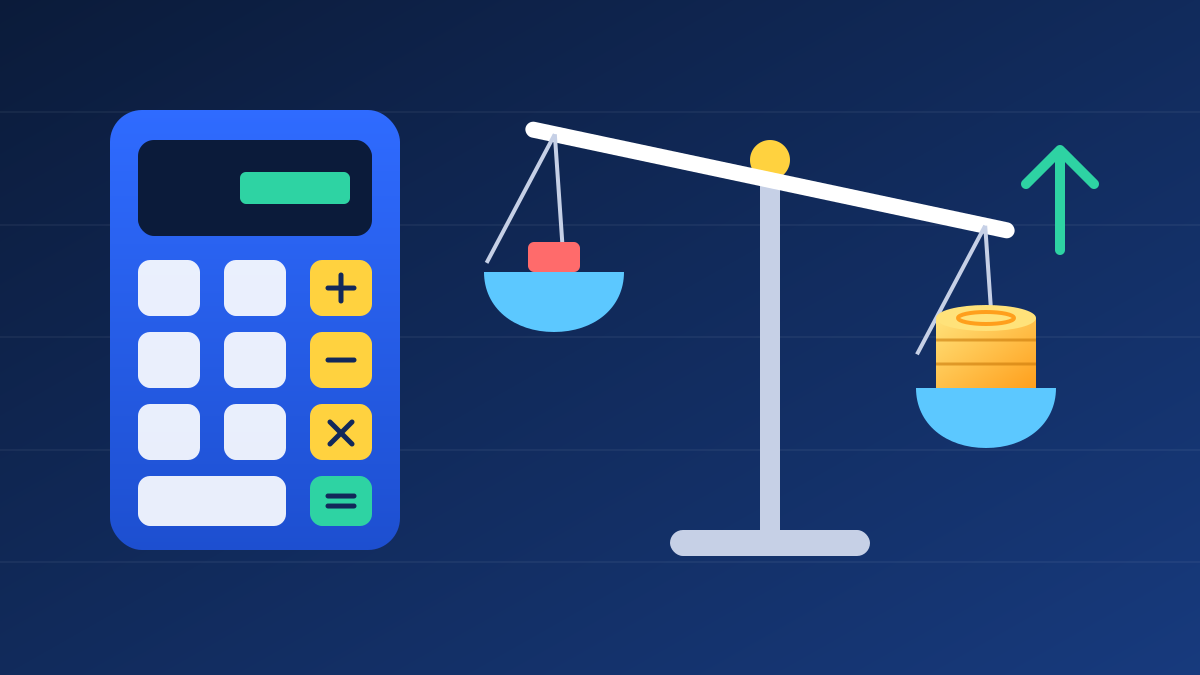
Many startups fail not because of a bad product but because they scale a loss-making model. The more customers they acquire, the more they lose. Unit economics lets you answer the key question in advance: does the business earn money on each customer, or does every sale increase the loss? In this article we cover the key metrics, formulas and a step-by-step calculation example.
What unit economics is and why you need it
Unit economics is a method of assessing business profitability through the revenue and costs attributable to a single unit. A unit can be one customer, one order, one subscription or one product sold. The choice depends on the model: for a subscription service it is usually a customer, for an online shop it is an order.
The calculation shows three important things:
- whether acquiring one customer pays off;
- how long it takes to recover the money invested in marketing;
- which parameters need improving before you invest in growth.
For investors, unit economics is one of the main arguments. If it works, additional money turns into growth. If not, it turns into burning capital faster.
Key metrics and formulas
- CAC (Customer Acquisition Cost) — the cost of acquiring one paying customer. Formula: total marketing and sales spend for a period / number of new customers in the same period.
- ARPU (Average Revenue Per User) — average revenue per user over a period, for example a month.
- Gross margin — the share of revenue left after the direct costs of serving the customer: servers, payment fees, support, cost of goods.
- Churn rate — the share of customers who stop using the product during a period. The average customer lifetime is roughly 1 / churn.
- LTV (Lifetime Value) — the gross profit a customer brings over the whole relationship. Simplified formula: ARPU × gross margin × customer lifetime.
- Payback period — the time to recover CAC: CAC / (ARPU × gross margin).
The golden rule: the LTV / CAC ratio should be at least 3, and the customer acquisition payback period should ideally not exceed 12 months.
How to calculate unit economics: a step-by-step example
Take a hypothetical SaaS service for small businesses with a subscription price of UAH 600 per month.
- Calculate ARPU. All customers pay the same plan, so ARPU = UAH 600 per month.
- Determine gross margin. Hosting, payment fees and support cost UAH 180 per customer. Margin = (600 − 180) / 600 = 70%, i.e. UAH 420 per month.
- Calculate churn. 5% of customers leave every month, so the average customer lifetime is 1 / 0.05 = 20 months.
- Calculate LTV. UAH 420 × 20 months = UAH 8,400.
- Calculate CAC. UAH 120,000 was spent on marketing in a month and 50 new customers arrived. CAC = UAH 2,400.
- Evaluate the result. LTV / CAC = 8,400 / 2,400 = 3.5. Payback period = 2,400 / 420 ≈ 5.7 months.
| Metric | Value | Assessment |
|---|---|---|
| ARPU | UAH 600 / month | — |
| Gross margin | 70% (UAH 420) | Good for SaaS |
| Churn | 5% per month | Room for improvement |
| LTV | UAH 8,400 | — |
| CAC | UAH 2,400 | — |
| LTV / CAC | 3.5 | The model works |
| Payback period | ≈ 5.7 months | Faster than the 12-month target |
In this example, every acquired customer brings in 3.5 times more than it costs to acquire them, and the costs are recovered in less than six months. A model like this can be scaled.
The break-even point and fixed costs
Positive unit economics does not yet mean the company is profitable. Besides per-customer costs, there are fixed costs: team salaries, rent, legal services, development. The break-even point is the moment when the total margin from all customers covers fixed costs.
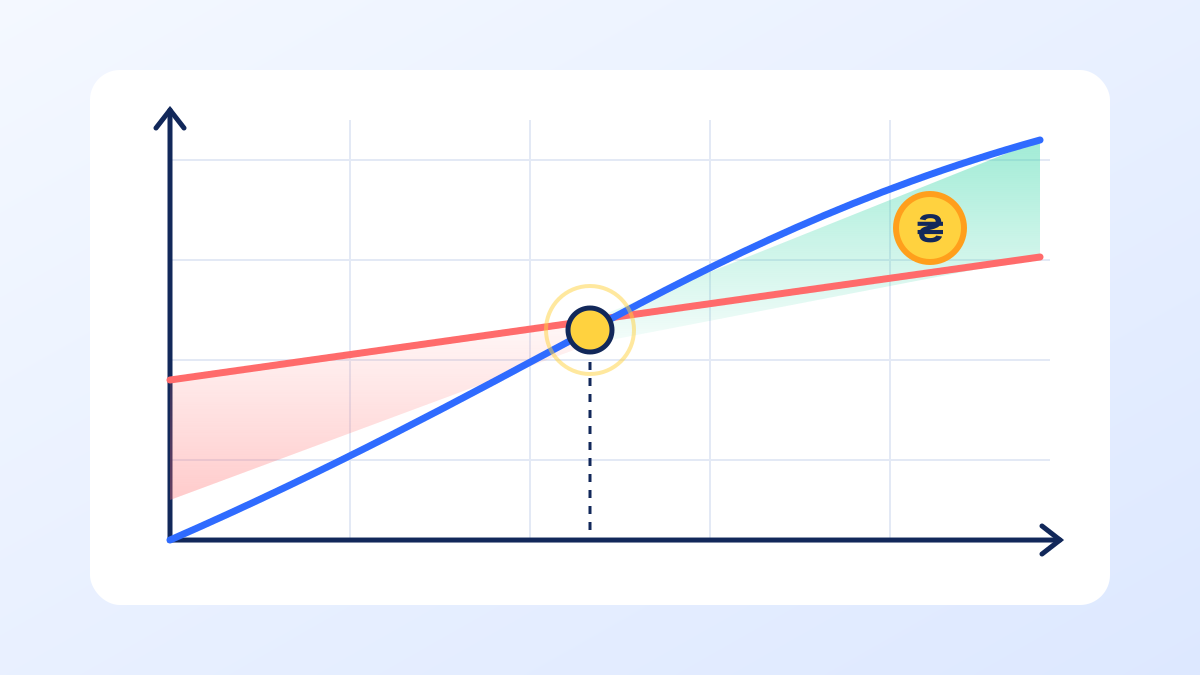
Formula: monthly fixed costs / monthly margin per customer. If fixed costs are UAH 630,000 and the customer margin is UAH 420, you need 1,500 active customers to break even. This number helps plan marketing and understand how much money must be raised from investors to reach self-sufficiency.
Common calculation mistakes
- Counting only the ad budget in CAC. Acquisition cost must include the salaries of marketers and salespeople, tools and partner commissions.
- LTV based on revenue rather than margin. This overstates customer value 2–3 times and creates an illusion of profitability.
- Too short a history. Churn in the first two months can differ greatly from real churn over a year.
- Averages across all channels. One channel may be highly profitable and another loss-making. Calculate the economics separately for each customer source.
- Ignoring cohorts. Compare the behaviour of customers who arrived in different months: this shows whether the product is improving.
When you can scale
Before increasing your marketing budget, run through a simple checklist:
- LTV / CAC is consistently above 3 in at least one acquisition channel.
- The customer payback period is shorter than the company’s runway.
- Churn does not grow as the number of customers increases.
- CAC does not spike as the budget grows — the channel has spare capacity.
- The team and processes are ready to serve several times more customers without losing quality.
Conclusions
Unit economics is a simple yet very powerful tool. It shows where the business makes money, where it loses it and which levers will have the greatest effect: lowering CAC, increasing the average order value or fighting churn. Calculate it regularly, by channel and cohort, and scale only what has already proved profitable. And if the numbers do not add up yet, start by validating demand with an MVP and low-cost growth channels.